Free genre identifier tool
“What genre is my story?”
Get a FREE, structured genre diagnosis of your screenplay or novel in minutes.
True genre | Subgenre | Plot conventions | Audience expectations | References
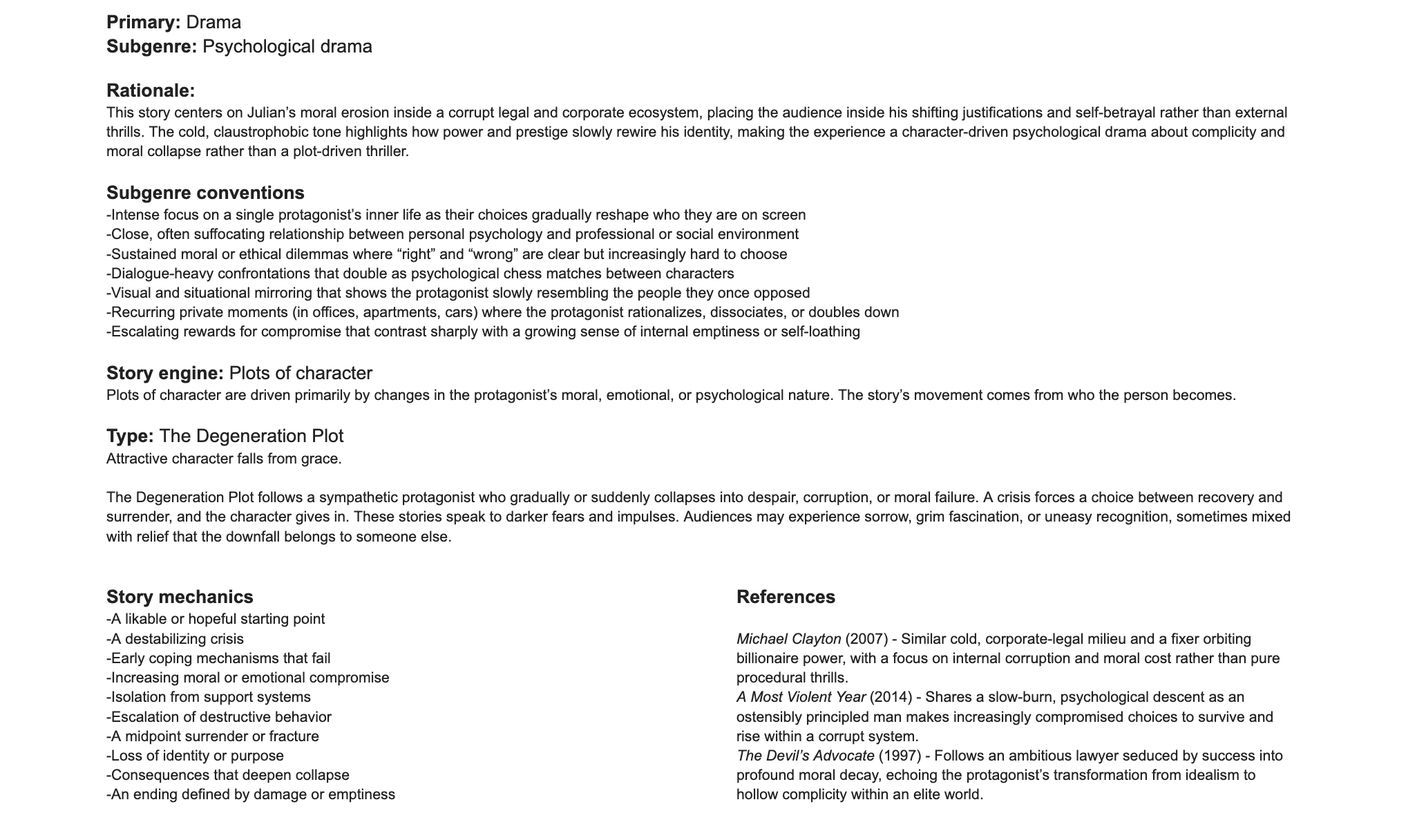
Example genre diagnosis (real output)
How it works:
Answer 4 questions about your story.
Check your inbox.
Finish your draft.
Genre is NOT “marketing”
Ignore Reddit on this. Genre is to story what blueprints are to buildings:
Establishes structural foundations
Classifies protagonist–antagonist relationships
Ensures tonal consistency
Lets you balance novelty and convention
Avoids cognitive dissonance in the audience
Connects to your logline (see the free logline generator tool for a helping hand)
In other words, an architect can’t build a hospital with a bungalow’s blueprints.
And a writer can’t build a psychological drama with the engine of an action thriller.
Genre quietly determines what kind of story is even possible. It governs the levels of conflict, what kind of solutions feel satisfying, what kind of ending lands, and what kind of meaning the audience walks away with.
This is why many drafts feel “off” even with strong moment-to-moment writing. Scenes may work individually, but they’re being assembled with the wrong parts. To extend the metaphor; try manufacturing a truck with scooter parts.
Because genre lives somewhat below the surface, most writers misdiagnose their problems as pacing, stakes, or character depth when what’s actually broken is the genre foundation.
What if my story fits more than one genre?
Many stories do. But it’s usually a combination, not a blend. And almost always, one genre is dominant.
When true “blends” work, they tend to be between highly compatible genres (action–thriller, romance–comedy, crime–mystery).
When less compatible genres collide, one takes control.
Horror–comedy, for example, always skews comedic. Think Shaun of the Dead (2004). Were you scared? No. The horror serves the comedy, not the other way around.
So you might have a romance storyline inside a thriller. But the thriller is still doing thriller work: sustained danger, pursuit, and investigation. The romance simply adds emotional leverage to that danger (for example, the love interest is in jeopardy). Likewise, romantic payoff often hits harder after danger has been survived.
Again, think in terms of architecture.
A hospital can be designed in Art Deco, brutalist, or minimalist style. But no matter how it’s decorated, the visitor will still see operating rooms, triage wards, and medical systems. Its function determines its structure. If patients aren’t being treated, it simply isn’t a hospital.
Genre works the same way. If stuff isn’t discovered, it’s not a Mystery. If bullets aren’t flying, it’s not Action.
When writers say “my story fits more than one genre”, they’re usually either unsure which genre is actually dominant, or unfamiliar with how genre compatibility works.
The Genre Identifier tool here identifies the dominant story logic first, then the core subgenre shaping its flavor. It also analyzes your plot elements to identify your story’s plot engine as an extra structural layer.
Can a story change genres halfway through?
A hospital can serve ice cream. But if your hospital becomes an ice cream shop, you end up with suffering patients and bloody vanilla.
Stories should evolve. But true genre shifts are rare, risky, and usually unnecessary. Your story’s progression should serve its genre. The ice cream works because the patient was treated first.
Most stories that appear to “change genre” are actually:
revealing their true genre late
escalating into a deeper subgenre
or paying off expectations that were planted early
What often gets called “genre switching” is usually delayed clarity.
Actual mid-story genre replacement leads to tonal whiplash and unsatisfying audience experiences. It may feel “creative” for the writer, but ends up doing a mediocre job at two things instead of a strong job at one.
Successful genre blends don’t replace one genre with another. They stack them in a way that keeps one audience experience dominant. Your Action might be thrilling, or your Thriller packed with action. But you don’t stop the Rom-Com and switch to a Ne-noir crime mystery.
Understanding, and committing to, your primary genre early makes it much easier to be creative in ways that actually serve the audience, rather than confuse them.
What’s the difference between genre and subgenre?
A primary genre sets fundamental expectations.
Drama says emotion. Thriller says shaking hands. Horror says… horror. And so on.
In cooking terms: appetizer, main course, dessert.
A subgenre defines the character of the experience.
Psychological thriller
Folk horror
Romantic comedy
Crime drama
Dystopian sci-fi
In cooking terms: is your dessert a Flan? A fruit bowl? A granola yogurt?
Primary genre answers: “What kind of story experience is this?”
Subgenre answers: “What will that expected experience feel like, specifically?”
Strong genre identification almost always requires both. The primary signs a contract. The sub lays out the clauses and conditions.
Is genre decided by theme or by plot?
Neither, by itself.
Theme is the narrative point the writer makes about the human experience.
Plot is the vehicle that gets you there; the events that prove the point through cause-and-effect.
That said, genre conventions by nature set parameters around what kinds of themes and plots are appropriate.
Here’s a thought experiment:
Part 1: Guess the genre the following theme implies:
Love prevails when we learn to stop depending on others.
Hint: it’s not horror.
Part 2: Guess the genre of the following plotline:
A former Navy SEAL returns from retirement to tackle an extraterrestrial threat.
Hint: it’s not romance.
Two stories can share the same theme and the same basic plot events, yet belong to completely different genres.
Example plotline:
A man builds a machine to communicate with his dead wife.
Theme:
Happiness depends on our ability to let go of the past.
This same plotline and theme combo can be usd to shape a romantic comedy, horror, or psychological drama.
The genre determines the path the story takes:
If it’s a romantic comedy, the machine becomes an emotional crutch he must give up in order to open himself to new love.
If it’s a psychological drama, the machine works too well. He spirals into despair, traps his wife’s “ghost” in a closet, and seals himself off from love forever because he can’t bear the thought of never speaking to her again.
Same theme. Same plot premise. Different genre.
Is there a tool that tells you your genre?
Yes, you’re looking at it. And yes, it’s free.
👉 Try it here.
The Genre Identifier gives you a structured diagnosis of your story’s:
Primary genre
Subgenre
Plot conventions
Audience expectations
References
It only asks four questions, then emails you a full breakdown in minutes.
This tool was made by writers, for writers. It has a well-researched, multi-layer analysis framework that guarantees much better results than if you just consult ChatGPT.
Story toolkit: Logline Generator and Writer’s Block Fixer
Pair the Genre Identifier with the free Logline generator and the (not free) Writer's Block Fixer tool (our flagship product) for a major head start when finishing your draft.
The Writer’s Block Fixer gives you targeted writing exercises based on your specific writing problems (whether they are genre, character, dialogue, plot, scene, world building, or writing routine).